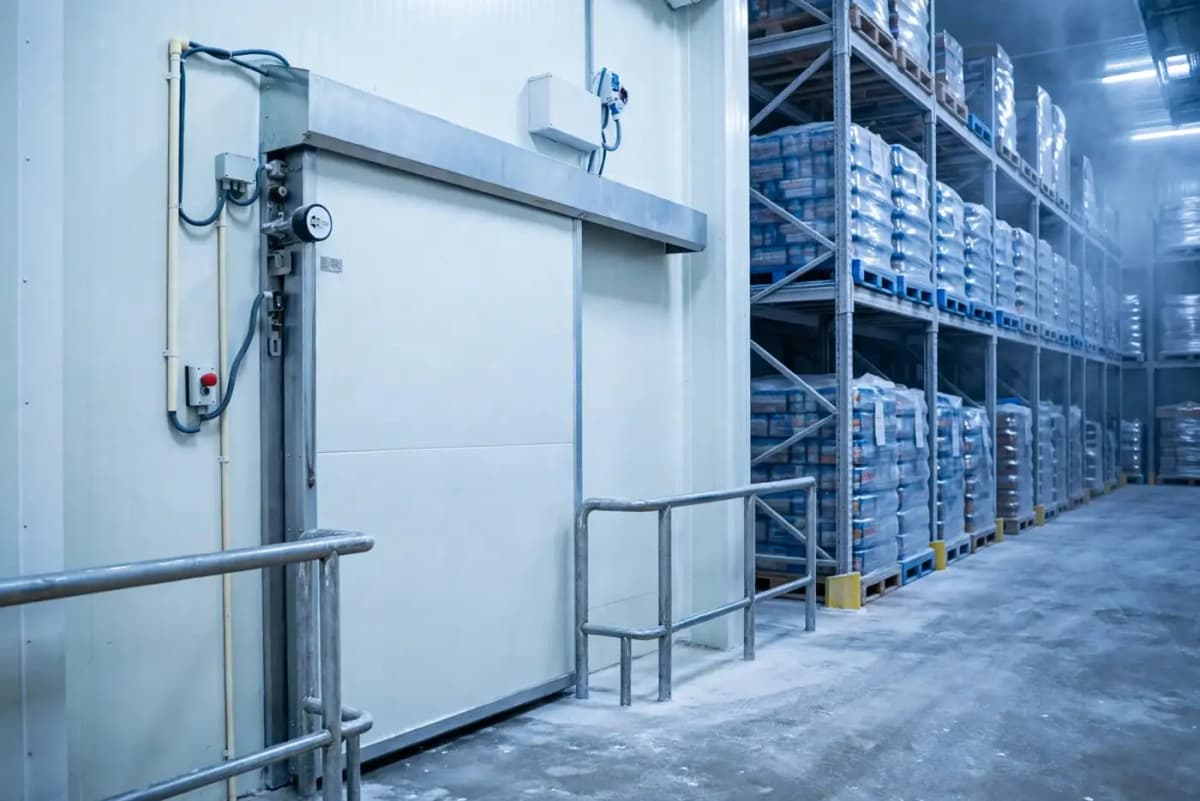
Cold-Chain Doors
Egis FrostGlide F120
Insulated freezer sliding door rated to -28 C, with ice-free sealing.
Insulated freezer sliding door rated to -28 C, with a 120 mm core, heated frame and threshold heating to stop ice build-up.
Overview
Below zero, doors fail differently: gaskets freeze to frames, condensation becomes ice, and a door that sealed perfectly at +4 C will not close at -25 C. The FrostGlide F120 is engineered for the freezer band from 0 down to -28 C. Its 120 mm high-density polyurethane leaf, heated frame and low-temperature EPDM gasket system are designed around one goal — the door must close and seal fully, every cycle, at -28 C.
The heated frame is the key detail. At freezer temperatures the frame line is where moist ambient air condenses and freezes; ice builds up, the gasket cannot seat, and the seal degrades cycle by cycle until the door stands permanently ajar. The F120's frame heating keeps the sealing surfaces above freezing, while the double low-temperature gasket stays flexible at -28 C instead of turning brittle. The result is a door that seals like a chiller door but survives like a freezer door.
Operation is automatic at 0.4–0.8 m/s with manual backup, in single or double-leaf configurations for openings from 1000 to 4000 mm wide and 2200 to 4000 mm high — covering personnel doors through to full pallet-transfer openings. The food-safe coated steel face (stainless optional) handles washdown, and the drive's safety package follows the same EN 16005 discipline as the rest of the Egis automatic range.
How the F120 defeats ice at the seal line
Ice at the seal is a feedback loop: a little frost prevents full gasket compression, the resulting air leak brings more moisture, which freezes into more frost. The F120 breaks the loop at three points. First, the frame and threshold heating holds the sealing faces above 0 C so condensate cannot freeze there. Second, the low-temperature EPDM compound remains elastic at -28 C, so the gasket compresses fully instead of bridging over frost. Third, the down-and-in style seating action wipes and compresses the gasket in one motion rather than dragging across it.
The 120 mm injected core serves the -28 C band the way the C80's 80 mm serves the chiller band: matched insulation thickness for the temperature duty, keeping the leaf light enough for fast automatic cycling while holding the room's temperature with margin.
- Rated 0 C to -28 C; 120 mm high-density injected polyurethane core
- Heated frame and threshold — sealing faces stay ice-free
- Double low-temperature EPDM gaskets, flexible at -28 C
- Single or double leaf; openings 1000–4000 mm W x 2200–4000 mm H
- Automatic 0.4–0.8 m/s with manual option; food-safe finish, stainless optional
- Safety to EN 16005 with radar / pull-cord / remote activation
Applications
Frozen food storage
Reliable sealing for -18 to -25 C stores in food processing and distribution.
Ice cream and dairy freezers
Ice-free operation where washdown and sub-zero meet.
Pharma frozen storage
Tight thermal discipline for frozen pharma goods and clinical-trial material.
Cold logistics hubs
High-cycle freezer doors on pallet routes with heated thresholds.
In detail
Frequently asked questions
0 C to -28 C. For -40 C blast-freezer duty, Egis offers the BlastShield B170 with a 170 mm leaf and heated multi-point gasket system.
At sub-zero room temperatures, the frame line sits between -28 C inside and warm humid air outside. Moisture condenses and freezes on the sealing faces; ice prevents the gasket from seating, and each incomplete close admits more moisture. Frame heating keeps the sealing surfaces above freezing so the gasket compresses fully every cycle.
The door can be operated manually — the manual option is specified for exactly this case — and the heated frame simply de-energises. On power restoration the heating recovers the sealing faces before ice can establish. For critical stores, Egis recommends the door circuit on the facility's essential supply.
Single leaf to 4000 mm covers most pallet openings; double leaf splits the mass for very wide openings or where traffic needs a smaller active leaf for personnel while the full width opens for pallets. Egis sizes the configuration to the opening and traffic mix.
Thicker insulation (120 vs 80 mm), heated frame and threshold, low-temperature gasket compounds, and detailing for ice management — the F120 is a freezer door, the C80 a chiller door. Using a chiller door in a freezer room is the most common cause of premature door failure in cold stores.
Gasket inspection on cycle count, heater-circuit checks before the warm season (when condensation load peaks), track and roller inspection, and keeping the threshold drainage clear. Egis provides a freezer-specific maintenance schedule with each installation.
Related door systems
Cold-Chain Doors
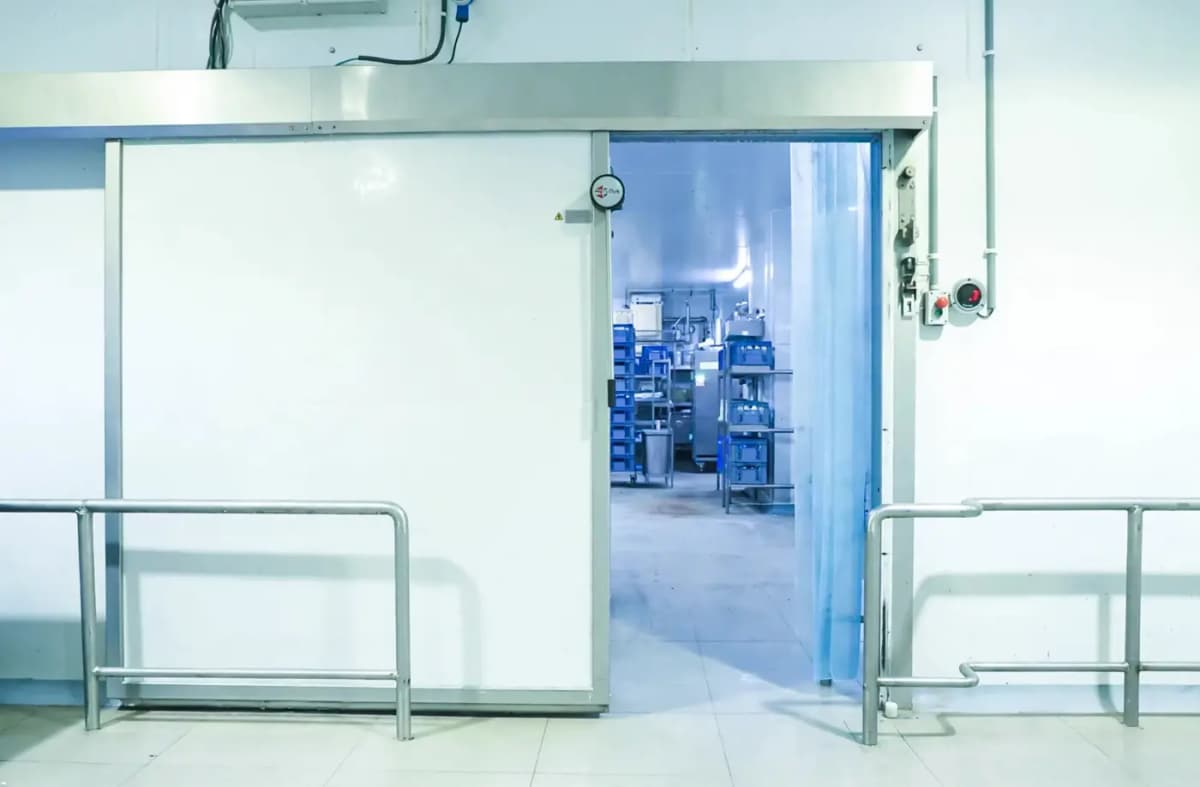
Egis ChillGlide C80
- Sliding door system
- Airtight sealing
- Low-temperature duty
- Completely smooth finishing
Insulated sliding door for chiller rooms from 0 to +15 C, with an 80 mm polyurethane core and fast automatic operation.
View specifications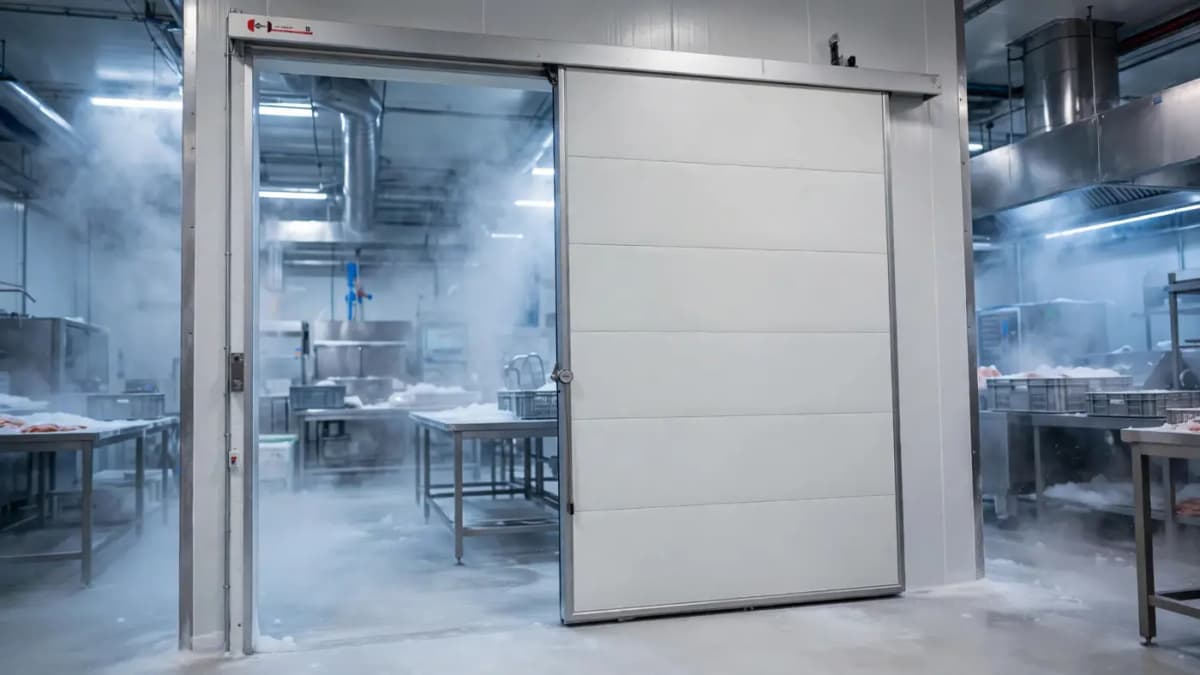
Cold-Chain Doors
Egis BlastShield B170
- Sliding door system
- Airtight sealing
- Low-temperature duty
Heavy-duty blast-freezer door rated to -40 C with a 170 mm insulated leaf for rapid-chill tunnels and blast cells.
View specifications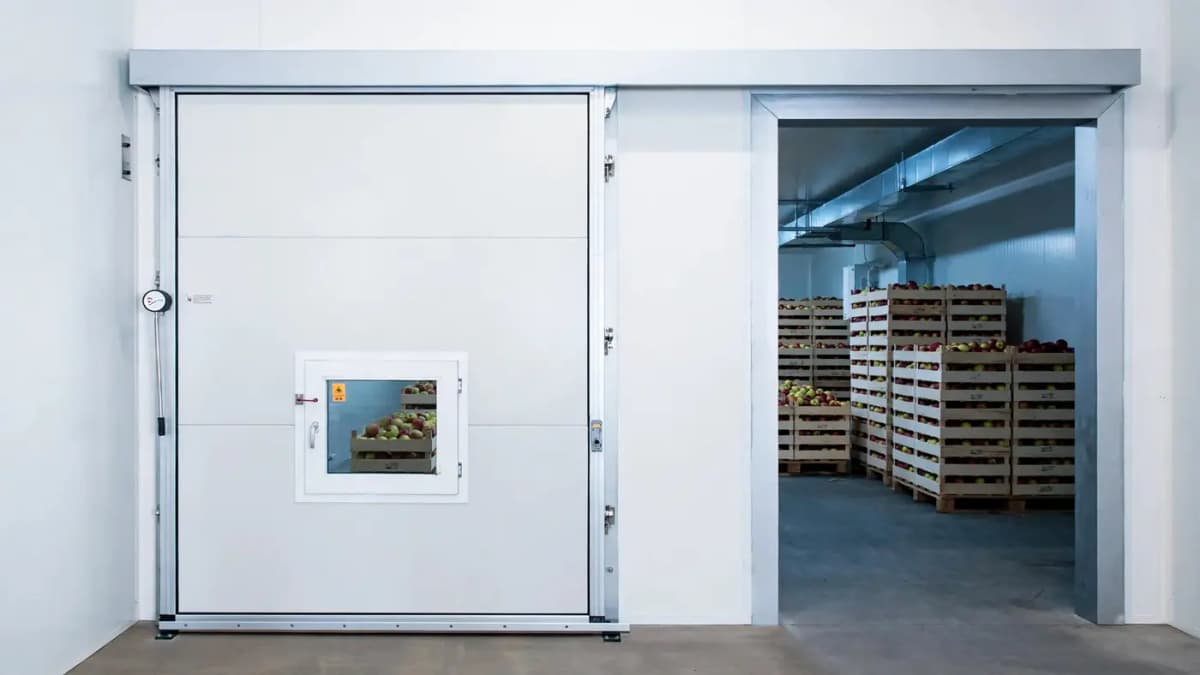
Cold-Chain Doors
Egis GasTight CA200
- Sliding door system
- Airtight sealing
- Gastight sealing
- Low-temperature duty
Gastight sliding door for controlled-atmosphere chambers, with inflatable perimeter gaskets and an integrated inspection and escape hatch.
View specifications